

Easy Plate YM-R
Yeast and Mould Count and Easy Plate YM-R
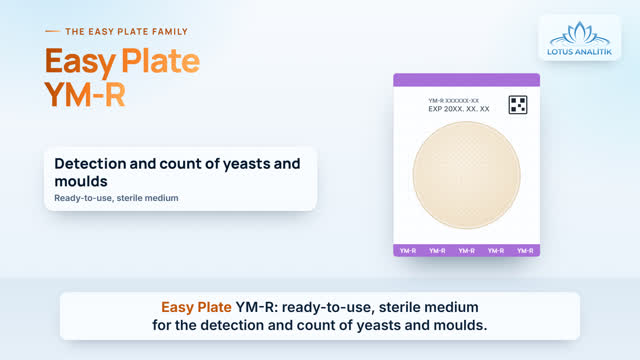
Yeasts and moulds are among the best-known causes of food spoilage. They stand out in acidic, sugary or dry products where bacteria struggle to grow. Here we look at why the yeast and mould count matters and how Easy Plate YM-R makes it easier.
Contents6 sections
Why count yeasts and moulds?
Yeasts and moulds can grow in more acidic, sugary and drier conditions than bacteria. That makes them a main cause of spoilage in many foods, such as fruit products, bakery goods, dairy products and sauces. The yeast and mould count helps:
- to judge the risk of spoilage over the product’s shelf life,
- to follow the state of raw materials and of the production environment (air, surfaces),
- to see whether storage conditions are adequate.
Because some moulds can produce mycotoxins, mould control matters for food safety as well as quality. Mycotoxin testing is a separate subject; see our mycotoxin test kits.
How are they counted the classic way?
Classic yeast and mould counts usually use media such as potato dextrose agar (PDA) or DRBC agar. Yeasts and moulds grow more slowly than bacteria, so incubation is long: in the comparison image in the Easy Plate e-catalogue, the PDA medium was incubated for 120 hours. Even then, spreading mould colonies can make counting difficult.
How does Easy Plate YM-R work?
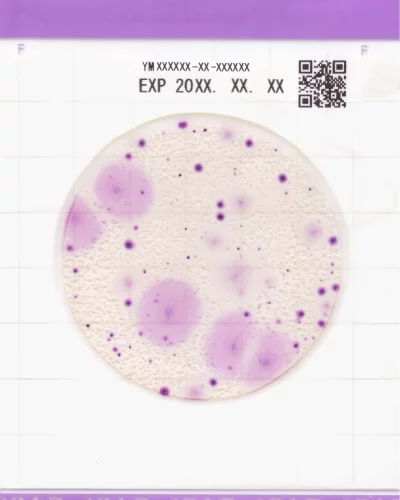
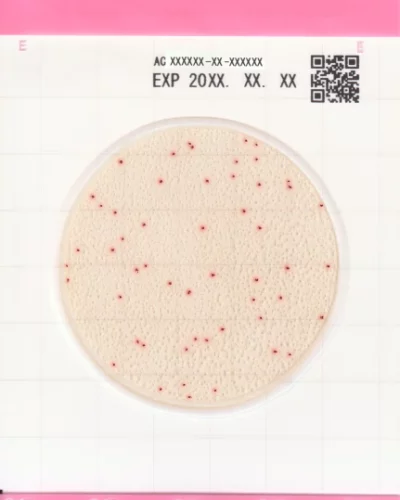
Easy Plate YM-R is a ready-to-use, sterile medium for detecting, identifying and counting yeasts and moulds. A colour change appears within 48–72 hours at 25 ± 1 °C. A redox indicator produces purple colonies, so colonies are easy to identify and count even when food particles are present.
Yeast and mould colonies look different on the plate:
- Mould colonies spread over a wide area and form purple colonies with diffuse edges.
- Yeast colonies form small circles with distinct edges.
- Target microorganism
- Yeasts and moulds
- Incubation
- 48–72 hours · 25 ± 1 °C
- Storage (unopened)
- 2–8 °C
- Shelf life
- 18 months from the date of manufacture
- Packing
- 100 tests (25 tests × 4 bags)
- Certification
- AOAC PTM 122401 · MicroVal 2022LR109 · NordVal 063
Agreement with the classic method
In the Easy Plate e-catalogue, YM-R results are compared with PDA and DRBC agar; the correlation coefficient is r = 0.97 in both. The data were provided by the Center for Fungal Consultation, a non-profit organisation. The catalogue shows Zygosaccharomyces rouxii, Geotrichum candidum, Aspergillus flavus, Aureobasidium pullulans, Saccharomyces cerevisiae, Penicillium glabrum and Candida parapsilosis, with examples from salad dressing, ham and sandwiches. See the colony images in the e-catalogue.
Points to watch when counting
- The incubation temperature is 25 ± 1 °C; if you share an incubator with bacterial plates, check the setting.
- Mould colonies spread over time, so count within the recommended period.
- If you report yeasts and moulds separately, look at colony shape (small with distinct edges, or spreading with diffuse edges).
Why Lotus Analitik?
Lotus Analitik is the Kikkoman Easy Plate distributor in Türkiye. We deliver Easy Plate YM-R from stock in Türkiye through the cold chain, install and train in your laboratory, and stay with you with technical support afterwards. Before you decide, you can ask for a trial sample and see Easy Plate YM-R for yourself.
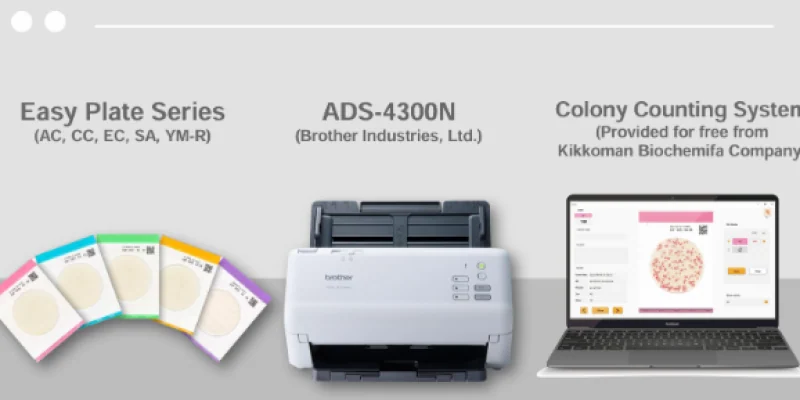
We cover the whole range in our article on ready-to-use media.
The Easy Plate range
More from this series
- Easy Plate ACTotal Aerobic Count and Easy Plate AC
- Easy Plate AC-RAerobic Count in 24 Hours: Easy Plate AC-R
- Easy Plate CCColiform Count and Easy Plate CC
- Easy Plate ECE. coli and Coliforms on One Plate: Easy Plate EC
- Easy Plate YM-RYeast and Mould Count and Easy Plate YM-R
- Easy Plate SAStaphylococcus aureus Count in 24 Hours: Easy Plate SA
- Easy Plate EBEnterobacteriaceae Testing and Easy Plate EB
Products