

Easy Plate AC
Total Aerobic Count and Easy Plate AC
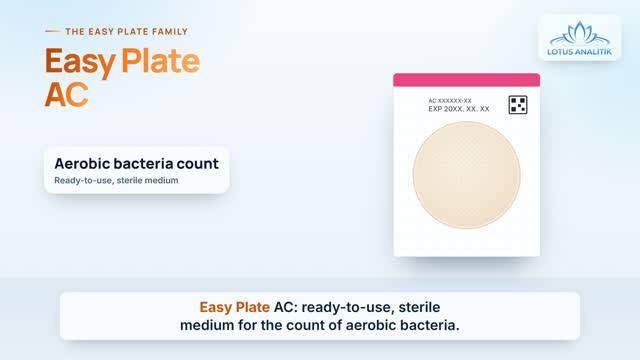
The total aerobic count is one of the most basic tests in food microbiology: it gives the total number of bacteria in a product that can grow in the presence of oxygen. Here we look at what the test shows, how it is done the classic way and how Easy Plate AC makes the count easier.
Contents6 sections
What does a total aerobic count show?
Also known as the “total mesophilic aerobic count” or “total viable count”, this test does not look for a specific pathogen; it measures the overall microbial load of a product. That is why it is used as a quality indicator:
- It shows how clean the raw material arrives.
- It helps to follow the effect of production and cleaning; a rising count in the same product can signal that something in the process has changed.
- In shelf-life studies it tracks how the product changes over time.
A single result says little on its own. The real value comes from following results from the same product and the same point regularly.
How is it done the classic way?
The classic count is usually done on plate count agar: the medium is weighed and prepared, sterilised and poured into Petri dishes; the diluted sample is plated and the colonies are counted after incubation. Media preparation and telling colonies apart from food particles take the most time. We explain how to dilute in Lab Tip #1.
How does Easy Plate AC work?
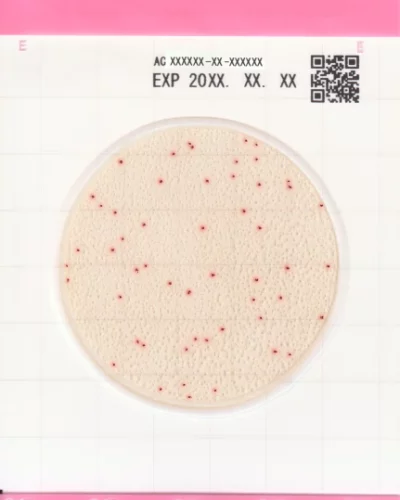
Easy Plate AC is a ready-to-use, sterile medium for counting aerobic bacteria, with no preparation or sterilisation needed. Its special formulation supports red colony growth: colonies appear bright red and are easy to identify and count after 48 ± 2 hours of incubation at 35 ± 1 °C. The clear colour makes counting easier.
- Target microorganism
- Aerobic bacteria
- Incubation
- 48 ± 2 hours · 35 ± 1 °C
- Storage (unopened)
- 2–8 °C
- Shelf life
- 18 months from the date of manufacture
- Packing
- 100 tests (25 tests × 4 bags)
- Certification
- AOAC PTM 041302 · MicroVal 2021LR102 · NordVal 059
Agreement with the classic method
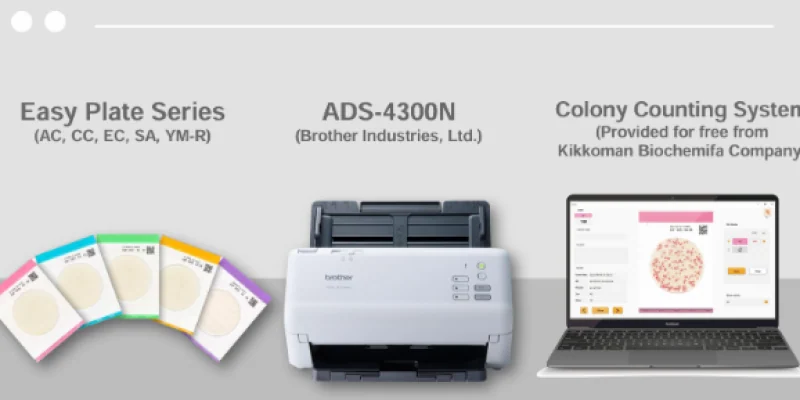
In the Easy Plate e-catalogue, Easy Plate AC results are compared with plate count agar; the correlation coefficient is r = 0.97. The catalogue also shows E. coli, Proteus mirabilis, S. aureus and three Bacillus species (B. subtilis, B. cereus, B. licheniformis) on the plate, and examples with foods such as raw salmon, raw ground chicken, raw bean sprouts, chocolate and ice cream. See the colony images in the e-catalogue.
AC or AC-R?
The second aerobic plate of the range, AC-R, gives results in 24 ± 1 hours. AC, on the other hand, holds MicroVal and NordVal certification besides AOAC PTM; AC-R is AOAC PTM certified only. Which one suits you depends on how soon you need the result, the reference method you work with and how your laboratory is organised. See our AC-R article for details.
Why Lotus Analitik?
Lotus Analitik is the Kikkoman Easy Plate distributor in Türkiye. We deliver Easy Plate AC from stock in Türkiye through the cold chain, install and train in your laboratory, and stay with you with technical support afterwards. Before you decide, you can ask for a trial sample and see Easy Plate AC for yourself.
We cover the whole range and the general benefits of ready-to-use media in our article on ready-to-use media.
The Easy Plate range
More from this series
- Easy Plate ACTotal Aerobic Count and Easy Plate AC
- Easy Plate AC-RAerobic Count in 24 Hours: Easy Plate AC-R
- Easy Plate CCColiform Count and Easy Plate CC
- Easy Plate ECE. coli and Coliforms on One Plate: Easy Plate EC
- Easy Plate YM-RYeast and Mould Count and Easy Plate YM-R
- Easy Plate SAStaphylococcus aureus Count in 24 Hours: Easy Plate SA
- Easy Plate EBEnterobacteriaceae Testing and Easy Plate EB
Products