

Lab Tip #5
Lab Tip #5: Is Measuring ATP Alone Enough?

ATP measurement is a widely used way to see within seconds whether a surface has really been cleaned. But looking at ATP alone can mislead in some cases: the surface looks clean, but is not.
Contents4 sections
What does ATP measurement show?
ATP (adenosine triphosphate) is an energy molecule found in living cells and in food residues. The ATP in a surface sample is measured through a light-producing reaction: the more light, the more living cells or organic residue on the surface. That is why ATP measurement is a fast indicator of living cells and organic residue on a surface.
Over time, ATP breaks down into ADP and AMP
If only ATP is measured, the result can be misleading in some cases, because ATP breaks down into ADP and AMP over time. On surfaces treated with heat, chemicals or disinfectant that still carry a contamination risk, the ATP level can be low while ADP and AMP are high. A system that measures ATP alone may show such a surface as clean.
Especially in processed meat, fish and chicken products, high sensitivity that also measures ADP and AMP is needed to detect residues thoroughly.
When ATP + ADP + AMP are measured together
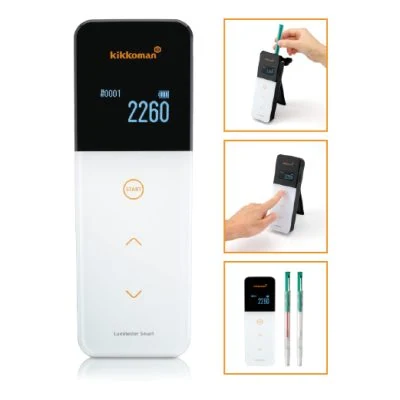
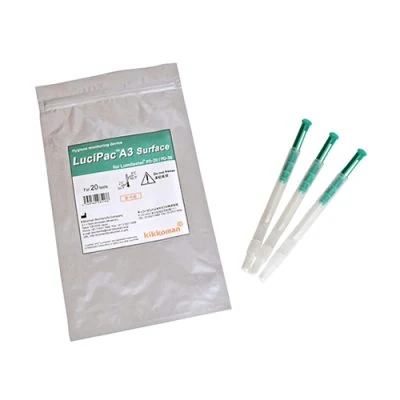
Kikkoman’s A3 technology measures all three together with the ATP cycling method, revealing surfaces that “look clean but aren’t”. Lumitester Smart makes this measurement in 10 seconds. Results are shown as numbers and graphs and sent over Bluetooth to a phone, tablet or computer. The same swab can be used on surfaces, equipment, drinking and process water, and staff hands and clothing.
How is it used in practice?
- 01
Set your control points and the lower and upper limits for each one.
- 02
Take a sample from a 10 × 10 cm area with the swab.
- 03
Start the measurement; the result appears on the device and in the app within seconds.
- 04
Results are saved automatically; follow the trend over time and, where a limit is exceeded, clean again and measure again.
Lumitester Smart lets production sites, food factories, pharmacies, hospitals and caterers test their cleaning and disinfection effectively. For storing the swabs correctly, see Lab Tip #3.
For installation, training and a demo, write to us. You will find the other posts of the Lotus Analitik lab tips series below.
Lab Tips
More from this series
- Lab Tip #1Lab Tip #1: How to Make the First Dilution
- Lab Tip #2Lab Tip #2: Why Is There Salt in Dilution Fluid?
- Lab Tip #3Lab Tip #3: How Should Hygiene Swabs Be Stored?
- Lab Tip #4Lab Tip #4: How Should Easy Plate Be Stored?
- Lab Tip #5Lab Tip #5: Is Measuring ATP Alone Enough?
- Lab Tip #6Lab Tip #6: When Should Frying Oil Be Changed?
- Lab Tip #7Lab Tip #7: Why Does pH Matter So Much?
- Lab Tip #8Lab Tip #8: What Is Water Activity?
Products